Multi Jet Fusion delivers isotropic, high-strength nylon parts at production speed. Superior surface finish, dimensional accuracy and mechanical consistency versus SLS — the benchmark powder bed process for functional prototypes and end-use production parts.
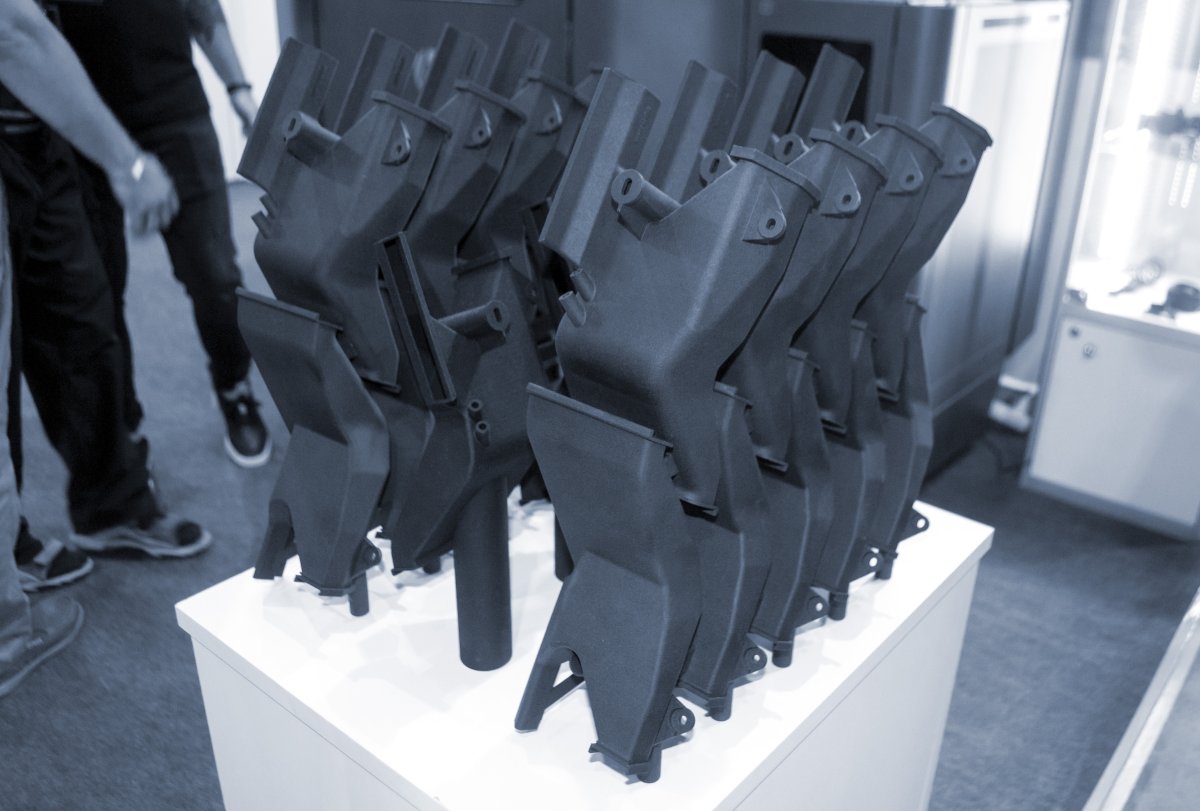
MJF uses HP's thermal inkjet array to apply fusing and detailing agents across a nylon powder bed, then fuses the entire layer simultaneously with infrared energy. The result: isotropic mechanical properties, smooth surface finish and tight tolerances — at throughput rates far exceeding SLS. It is the preferred process when production volume, dimensional consistency and functional part performance are required.
Isotropic Mechanical Properties
Uniform strength in X, Y and Z axes — critical for functional end-use parts and assemblies under multi-directional load.
Superior Surface Finish vs SLS
Finer detail resolution and smoother as-built surfaces. Less post-processing required to achieve specification finish.
No Support Structures Required
Unfused powder supports the build. Complex internal channels, undercuts and interlocking assemblies print without support waste.
High-Volume Production Ready
Batch production of hundreds of parts per run. Consistent part-to-part dimensional repeatability across the full build volume.
| Parameter | Specification |
|---|---|
| Max Build Volume | 380 x 380 x 280 mm |
| Layer Thickness | 0.08 mm (80 µm) |
| Dimensional Accuracy | ±0.3% (min ±0.3 mm) |
| Minimum Wall Thickness | 0.5 mm (recommended 0.8 mm) |
| Surface Finish (Ra) | 5–10 µm as-built (improvable with vapour smoothing) |
| Standard Lead Time | 3 – 5 business days |
| Accepted File Formats | STL, STEP, OBJ, 3MF, IGES |
6 engineering materials covering structural nylon, flexible TPU and glass-filled grades for demanding mechanical applications.
The workhorse MJF material. Excellent chemical resistance, good fatigue life and superior isotropy. Ideal for functional prototypes and end-use parts across all industries.
Rigid3–5 daysSame mechanical profile as PA12 Grey with uniform black pigmentation through-body. Preferred for consumer electronics and UV-exposed components.
Rigid3–5 daysHigher elongation at break versus PA12. Superior impact resistance. Best for hinge mechanisms, snap-fits, wearable devices and ducting components.
Semi-flex3–5 daysGlass microspheres for increased stiffness, dimensional stability and heat resistance. For structural housings and jigs requiring reduced creep.
RigidGlass-Filled3–5 daysThermoplastic polyurethane for highly flexible, rubber-like parts. Excellent abrasion resistance and tear strength for gaskets, grips and connectors.
Flexible5–7 daysStandard PA12 dyed to RAL or Pantone specification for consumer products and colour-coded assemblies.
RigidColour5–7 daysFull traceability from CAD upload to QA sign-off and dispatch.
Submit STL/STEP. Receive detailed quote with DfAM feedback.
Nesting optimised for packing density. Orientation selected for best mechanical performance.
HP thermal agents applied layer by layer. Full-layer infrared fusion at 80µm resolution.
Cake breakout, bead blast, shot peening. Vapour smoothing, dyeing or painting as specified.
Dimensional inspection, job card sign-off. Packed and dispatched with full tracking.
We work with engineers, designers and procurement teams across Australia every day.
"I would highly recommend Pratik at 3D Printing — with his analytical mind he helped re-engineer a component for an electric scooter. The final design was cost effective, strong and an exact fit."
"Can't speak more highly of this Company. They overcame many difficulties through their tenacity and patience. I highly recommend this company for any 3D prototyping, design or development of your idea."
"Great service, quick turnaround — I needed parts scanned, a couple of design changes and printed. All done quickly, efficiently and A+ quality. Definitely recommend the team at 3D Prototyping."
"It was a pleasure dealing with 3D Prototyping. They are professional and their customer service is excellent. I would recommend these guys any time over any other players in this industry."
"This Company is good, efficient and easy to deal with. Their advice and knowledge around materials really helped us get what we needed. Great service provided. We will certainly use this company again."
Our engineers review every enquiry personally. Upload your CAD file for a detailed quote, or send a brief description and we'll respond within 2 business hours.
We accept STL, STEP, STP, OBJ, IGES, and 3MF. STL is preferred for most processes. If your file is in another format, upload what you have and our engineering team will assess it.
Standard lead times depend on the technology, part complexity, and production method. They range from 3–5 business days for prototypes to 8–10 weeks for injection-moulded parts. Accurate lead times are provided with every quote.
Build envelopes vary by system: SLA up to 800×800×550mm; SLS up to 360×360×420mm; MJF up to 380×380×280mm; SLM up to 450×450×500mm; FDM up to 1000×1000×1000mm. Oversized parts can be split and bonded — contact us for a feasibility review.
There is no minimum order quantity. We regularly produce single prototypes through to production runs of thousands of parts. Pricing scales with volume — ask us for a batch quote.
Yes. We offer media blasting, dyeing, priming, painting, sanding, vapour smoothing, and custom colour matching. All post-processing is handled in-house to maintain full quality control and traceability.
Absolutely. All client files and intellectual property are treated as strictly confidential. We are happy to sign a mutual NDA before receiving your files — just ask.
Yes. We ship to all states and territories across Australia with same-day dispatch for completed orders.
Australia’s production-grade 3D printing and manufacturing bureau. From concept to production — one team, one NDA. Delivering nationwide since 2008.
©2026 All rights reserved
