FDM delivers cost-effective thermoplastic parts across the widest material range in additive manufacturing. The go-to process for large structural prototypes, jigs, fixtures and engineering-grade functional parts.
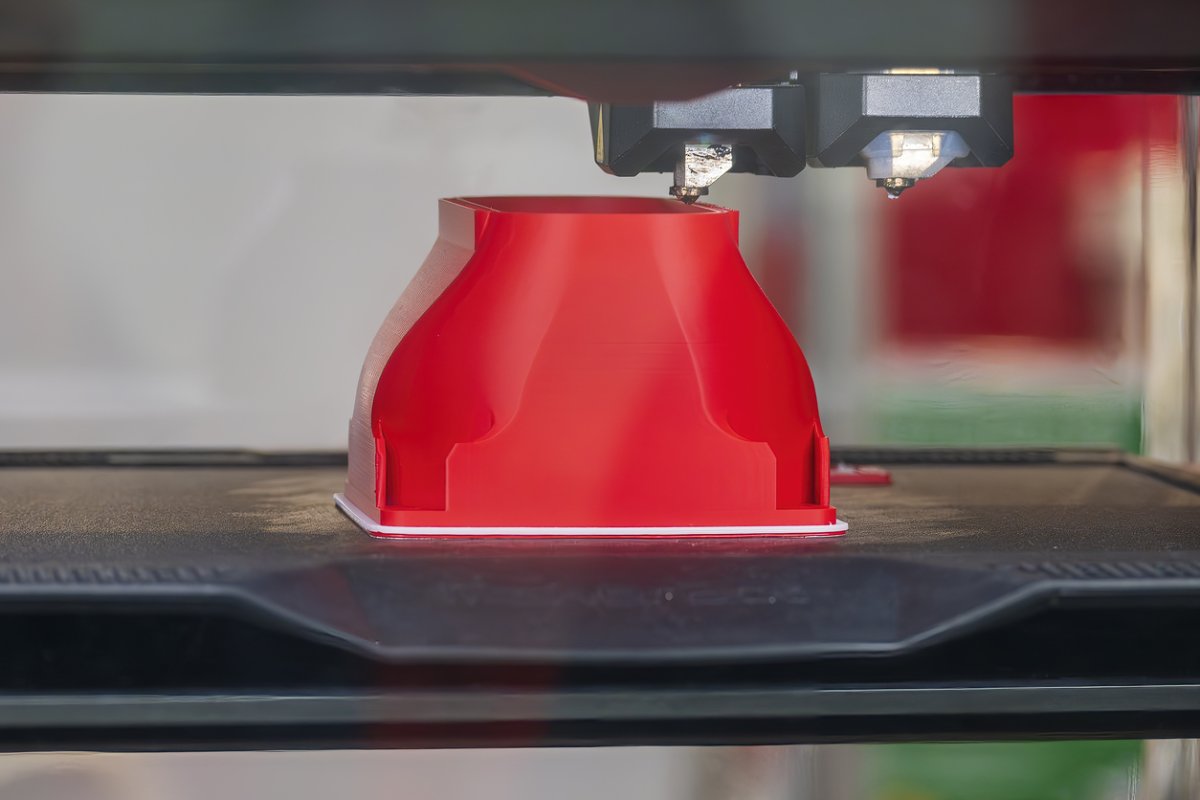
FDM extrudes thermoplastic filament through a heated nozzle, building parts layer by layer on a heated build plate. The process offers the widest material selection of any additive technology from commodity PLA through to high-performance PEEK and carbon fibre composites at the lowest cost per kilogram of deposited material.
✓ Widest Material Range
PLA, ABS, ASA, PETG, Nylon, PC, TPU, CF-filled and PEEK. Match material properties precisely to application requirements.
✓ Large Build Volumes
Build volumes up to 450 x 450 x 500 mm. Large structural housings, brackets and fixtures in a single print.
✓ Lowest Cost per Part
Most cost-effective additive process for large parts and low-detail prototypes where surface finish is not critical.
✓ Engineering-Grade Thermoplastics
Nylon, PC and carbon fibre composites for structural end-use parts, tooling inserts and high-temperature applications.
| Parameter | Specification |
|---|---|
| Max Build Volume | Up to 1000 x 1000 x 1000 mm |
| Layer Thickness | 0.1 – 0.3 mm |
| Dimensional Accuracy | ±0.3 mm or ±0.3% |
| Min Wall Thickness | 0.8 mm (recommended 1.2 mm) |
| Nozzle Temperature | Up to 300°C (PEEK capable) |
| Standard Lead Time | 2–5 business days |
| Accepted File Formats | STL, STEP, OBJ, 3MF, IGES |
12 engineering-grade thermoplastics covering every application from concept models to high-performance end-use parts.
General-purpose biodegradable polymer. Excellent printability, low warping and good surface finish. Ideal for concept models, display parts and low-stress prototypes.
Standard2–3 daysGood impact resistance and machinability. ASA offers superior UV stability for outdoor applications. Common for functional prototypes and automotive parts.
Engineering2–3 daysExcellent chemical resistance and toughness. Low moisture absorption. Ideal for food-safe housings, medical enclosures and parts requiring good impact strength.
Engineering2–3 daysHigh toughness, excellent fatigue resistance and good chemical resistance. Used for functional gears, snap-fits, living hinges and structural end-use parts.
High Performance3–5 daysChopped CF reinforced nylon or PETG. High stiffness-to-weight ratio. Used for lightweight structural brackets, tooling and parts requiring superior rigidity.
High PerformanceCF-filled3–5 daysFlexible, rubber-like thermoplastic. Excellent abrasion and tear resistance. Used for gaskets, over-mould simulations, grips and flexible enclosures.
Flexible3–5 daysFull traceability from CAD upload to QA sign-off and dispatch.
Submit STL/STEP. Receive detailed quote with material recommendation within hours.
Orientation optimised for strength, surface finish and minimal support. Infill and layer height selected to specification.
Thermoplastic extruded layer by layer on heated build plate. Enclosed chamber for engineering-grade materials.
Supports removed and parting lines cleaned. Sanding, priming or painting applied as specified.
Dimensional check and job card sign-off. Packed and dispatched with full tracking.
We work with engineers, designers and procurement teams across Australia every day.
"I would highly recommend Pratik at 3D Printing — with his analytical mind he helped re-engineer a component for an electric scooter. The final design was cost effective, strong and an exact fit."
"Can't speak more highly of this Company. They overcame many difficulties through their tenacity and patience. I highly recommend this company for any 3D prototyping, design or development of your idea."
"Great service, quick turnaround — I needed parts scanned, a couple of design changes and printed. All done quickly, efficiently and A+ quality. Definitely recommend the team at 3D Prototyping."
"It was a pleasure dealing with 3D Prototyping. They are professional and their customer service is excellent. I would recommend these guys any time over any other players in this industry."
"This Company is good, efficient and easy to deal with. Their advice and knowledge around materials really helped us get what we needed. Great service provided. We will certainly use this company again."
Our engineers review every enquiry personally. Upload your CAD file for a detailed quote, or send a brief description and we'll respond within 2 business hours.
We accept STL, STEP, STP, OBJ, IGES, and 3MF. STL is preferred for most processes. If your file is in another format, upload what you have and our engineering team will assess it.
Standard lead times depend on the technology, part complexity, and production method. They range from 3–5 business days for prototypes to 8–10 weeks for injection-moulded parts. Accurate lead times are provided with every quote.
Build envelopes vary by system: SLA up to 800×800×550mm; SLS up to 360×360×420mm; MJF up to 380×380×280mm; SLM up to 450×450×500mm; FDM up to 1000×1000×1000mm. Oversized parts can be split and bonded — contact us for a feasibility review.
There is no minimum order quantity. We regularly produce single prototypes through to production runs of thousands of parts. Pricing scales with volume — ask us for a batch quote.
Yes. We offer media blasting, dyeing, priming, painting, sanding, vapour smoothing, and custom colour matching. All post-processing is handled in-house to maintain full quality control and traceability.
Absolutely. All client files and intellectual property are treated as strictly confidential. We are happy to sign a mutual NDA before receiving your files — just ask.
Yes. We ship to all states and territories across Australia with same-day dispatch for completed orders.
Australia’s production-grade 3D printing and manufacturing bureau. From concept to production — one team, one NDA. Delivering nationwide since 2008.
©2026 All rights reserved
